For twenty years we optimized sites for Google. Now we need to explain them to machines that read the site instead of a human.
A search engine showed a person ten blue links — then the person figured things out on their own. An AI agent doesn’t work that way: it reads the page, understands it, and immediately answers the user or makes a decision — who to recommend, who to contact, what to buy. If the agent didn’t understand you, you’re not «lower in the rankings.» You’re simply not in the answer.
Good news: you don’t need a new site. You need to tidy up a few layers — and they only work together.
Three layers: gatekeeper, guidebook, passport
In short:
- robots.txt — decides who gets in at all, and points bots to
llms.txt. - llms.txt — a human-readable summary at the site root: who you are, services, contacts, key pages. A search engine crawls the whole site and guesses. For an agent, you provide a ready-made map.
- Schema.org / JSON-LD markup — a machine-readable passport for the page: not «nice text about the company,» but structured data — organization, contacts, services, and the relationships between them. Without it, the agent guesses. With it, the agent knows.
The gatekeeper lets you in, the guidebook explains, the passport confirms. Remove any layer — the chain breaks.
Honest caveat: llms.txt is a young standard — more of an emerging convention than an approved norm — and not all bots read it the same way. But it takes about half an hour, and it doesn’t hurt — so it’s on my checklist.
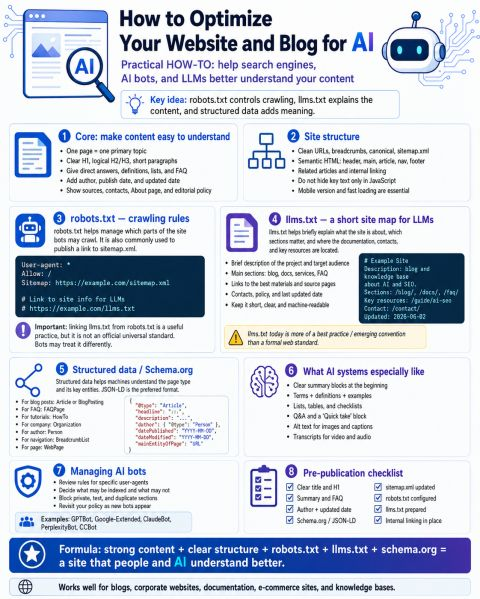
1. Core: make content easy to understand
No robots.txt will save a page that neither humans nor machines can parse.
- One page, one main topic.
- Clear H1, logical H2/H3, short paragraphs.
- Direct answers, definitions, lists, FAQs.
- Author, publish date, and update date.
- Sources, contacts, an About page, and an editorial policy.
2. Site structure
- Clean URLs, breadcrumbs, canonical tags,
sitemap.xml. - Semantic HTML:
<header>,<main>,<article>,<nav>,<footer>. - Related content and internal linking.
- Don’t hide important text inside JavaScript only.
- Mobile version and fast load times are mandatory.
3. robots.txt — crawling rules
The root file controls bot access to sections and points to the sitemap:
User-agent: *
Allow: /
Sitemap: https://example.com/sitemap.xml

# Link to site info for LLMs
# https://example.com/llms.txt
Linking to llms.txt in a comment is a useful practice, though not yet an official universal standard.
4. llms.txt — a short site map for LLMs
A root file (/llms.txt) briefly explains the site’s purpose, key sections, documentation, contacts, and top resources.
Example:
# Example Site
Description: Blog and knowledge base about AI and SEO.
Sections: /blog/, /docs/, /faq/
Key resources: /guide/ai-seo
Contact: /contact/
Updated: 2026-06-02
Include: a short project description, target audience, main sections, links to best materials, contacts, policy, and last update date.
5. Structured data / Schema.org
JSON-LD is the preferred format. Recommended types:
| Page type | Schema.org |
|---|---|
| Blog | Article, BlogPosting |
| FAQ | FAQPage |
| Instructions | HowTo |
| Company | Organization |
| Author | Person |
| Navigation | BreadcrumbList |
| General pages | WebPage |
Minimal article template:
{
  "@context": "https://schema.org",
  "@type": "Article",
  "headline": "...",
  "description": "...",
  "author": { "@type": "Person", "name": "..." },
  "datePublished": "YYYY-MM-DD",
  "dateModified": "YYYY-MM-DD",
  "mainEntityOfPage": "URL"
}
6. What AI systems especially like
- Clear summary blocks at the start of the content.
- Term → definition → example.
- Lists, tables, checklists.
- Q&A and «Quick take» / TL;DR blocks.
- Alt text on images and captions on illustrations.
- Transcripts for video and audio.
7. Managing AI bots
Review rules for specific user-agents. Decide what to index and what not to. Block private, test, and duplicate sections. Revisit robots.txt regularly — the bot list keeps growing.
User-agents worth managing: GPTBot, Google-Extended, ClaudeBot, PerplexityBot, CCBot.
8. Pre-publication checklist
- [ ] Clear title and H1
- [ ] Summary and FAQ included
- [ ] Author and update date present
- [ ] Schema.org / JSON-LD implemented
- [ ]
sitemap.xmlupdated - [ ]
robots.txtconfigured - [ ]
llms.txtprepared - [ ] Internal linking in place
Takeaway
The site stays the same for people. Now machines understand it too. In a world where an agent — not a person — increasingly picks the vendor, this isn’t «nice to have.» It’s hygiene.
The formula: strong content + clear structure + robots.txt + llms.txt + schema.org = a site that both people and AI understand better.
Works for blogs, corporate sites, documentation, e-commerce, and knowledge bases.
Agent artifact: generate llms.txt in 15 minutes
Theory above — now practice. This open repository lets readers hand their AI agent (Cursor,
Claude, ChatGPT, etc.) enough context to draft llms.txt plus a robots.txt
hint for their site.
Open the repository: ai-llms-generator on GitHub
Repository contents:
| File | Purpose |
|---|---|
SKILL.md |
Cursor Agent Skill — step-by-step workflow |
PROMPT.md |
Universal prompt for any chat |
template-llms.txt |
Empty template |
example-llms.txt |
Live example (blog.bezpalov.com/llms.txt) |
README.md |
Quick start |
Cursor
- Open the repository and copy
SKILL.md(and templates) into.cursor/skills/generate-llms-txt/in your project. - In chat:
/generate-llms-txt create llms.txt for https://my-site.com
Claude / ChatGPT / other agents
- Open PROMPT.md in the repository.
- Fill in URL, site type, language, and audience.
- Paste into chat → save output as
llms.txt→ deploy to the site root.
The agent will inspect the sitemap and navigation, pick key pages, and return a
robots.txt snippet. Verify URLs yourself before going live — the agent does
not replace judgment.
Originally published on LinkedIn.